
Bronx County Arrest Records Overview
An arrest record begins the moment NYPD or another agency takes a person into custody in the Bronx. The arresting agency generates the booking entry, pedigree information, charges as drafted by police, fingerprints, and a NYSID number. The Bronx County District Attorney then decides whether to file an accusatory instrument. If charges are filed, the matter is calendared for arraignment in Bronx Criminal Court at 215 East 161st Street or in Bronx Supreme Criminal Term at 265 East 161st Street depending on the charge level. The court case file becomes a separate record from the police arrest entry and from any later custody record.
The court side of Bronx arrest activity is searchable through WebCriminal using defendant name or case number. The custody side, if the person was held after arraignment, runs through the NYC DOC Person in Custody Lookup. Full case history, motions, dispositions, and sealed-record details belong to the court-records track covered on the Bronx County court records page. Bronx arrest records that ended in favorable terminations are sealed under CPL 160.50 and will not appear in standard public searches.
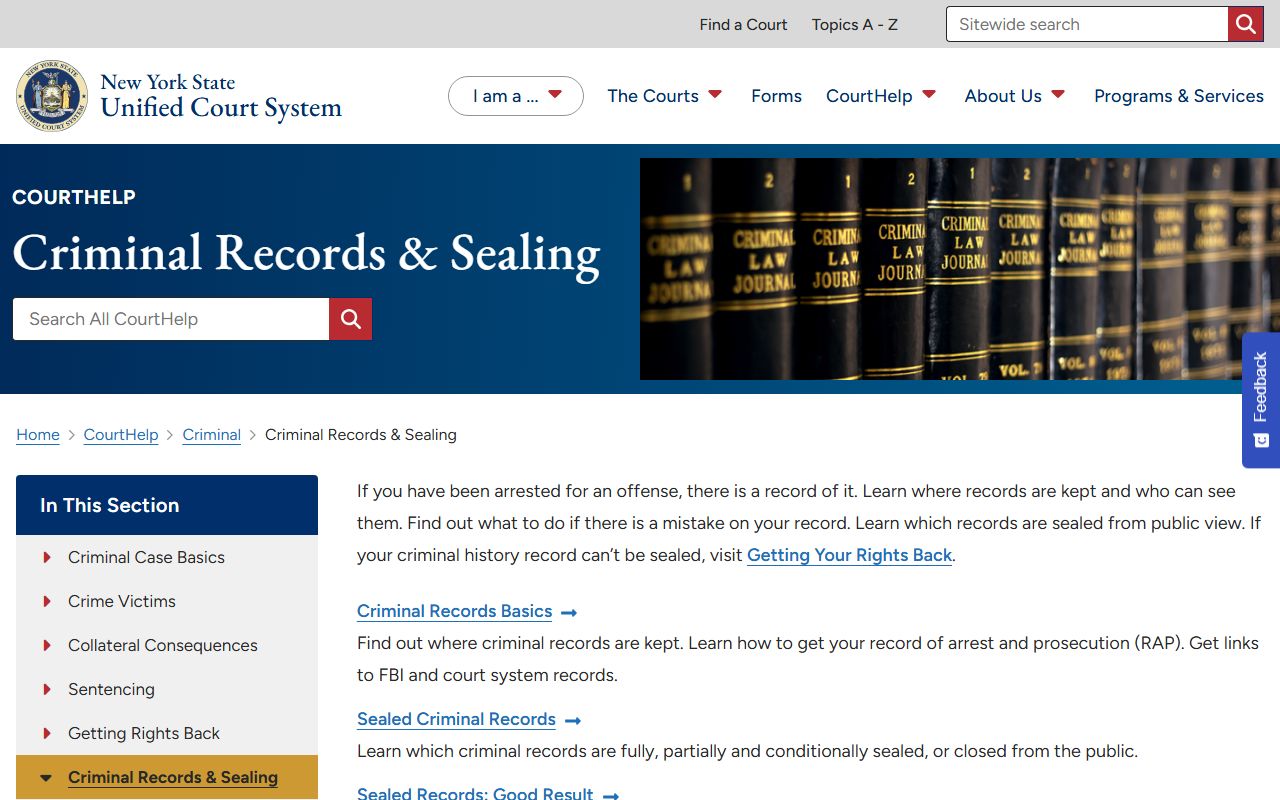
The NY Courts criminal-records overview is the best starting point for understanding what a Bronx arrest record looks like after a case ends.
How to Search Bronx County Arrest Records
Bronx County does not publish a public arrest blotter the way some county sheriffs do. The arrest information that the public can see runs through the court system after a case is filed, and through DOC custody if the person was held. Use the steps below to chase the most recent arrest data without relying on unofficial sites.
- Start with the NYC DOC Person in Custody Lookup. A current-custody result confirms the person is in NYC jail and shows basic case information, location, and identifiers.
- If DOC shows no result, the person may still be in NYPD or court processing. Recent arrests do not appear until DOC takes custody after arraignment.
- Search WebCriminal by defendant name. Enter at least the first two characters of the first and last name and limit the court to Bronx Criminal Court, Bronx Criminal Court - Summons, or Bronx Supreme Criminal Court.
- If a case number or summons number is known, use the WebCriminal case identifier search instead.
- For a final outcome on a Bronx Supreme case, request a certificate of disposition from the Criminal Term Central Clerk's Office on the second floor at 265 East 161st Street. The fee is $10 and a photo ID is required.
For older Bronx arrest activity, the County Clerk's pre-1992 microfiche index is the fallback for Supreme Court matters. Bronx Criminal Court keeps its own records for misdemeanor and summons cases.
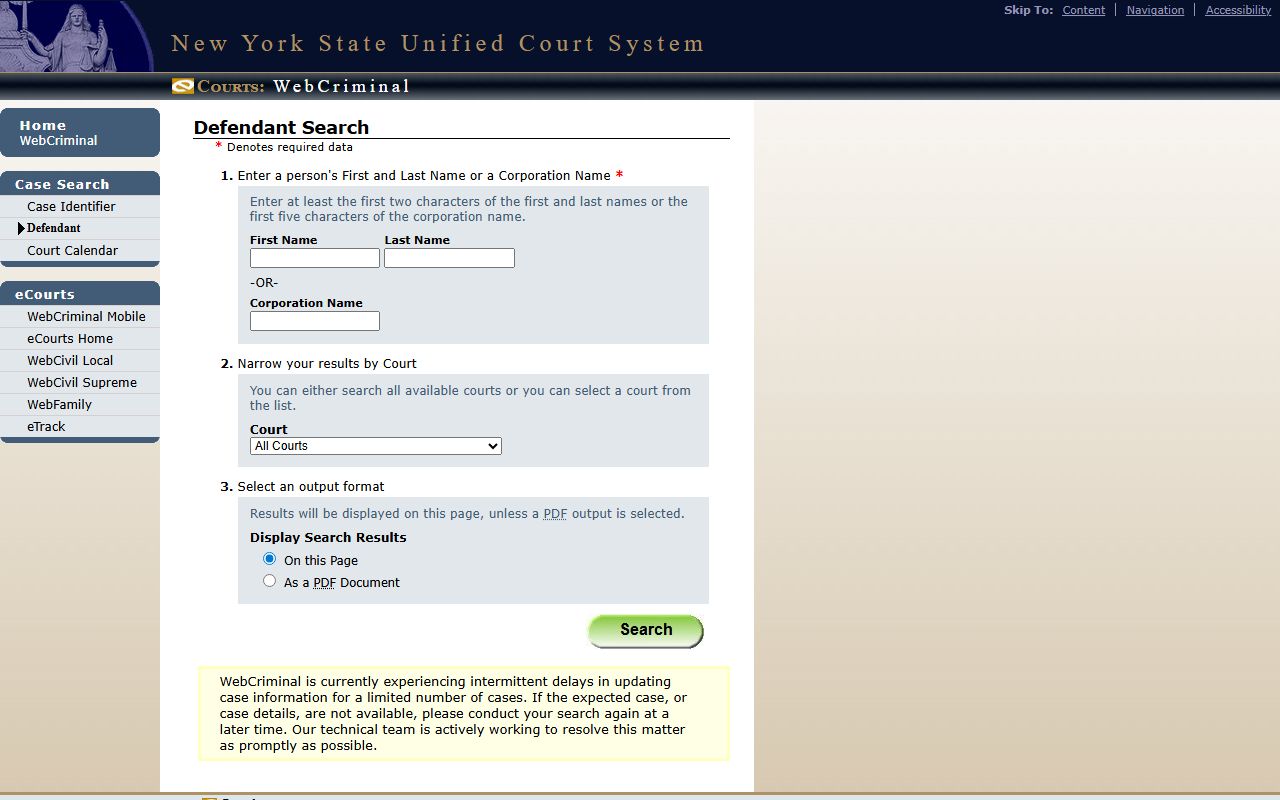
WebCriminal is the official statewide defendant search and is the closest thing the public has to a Bronx arrest case lookup.
WebCriminal Bronx Arrest Search Fields
The WebCriminal defendant search form has a short field set, but the rules are strict. A search with too little detail returns no result; too much detail produces a court mismatch. The table below lists every field and the official format note.
| Field Label | Type | Required | Notes / Format |
|---|---|---|---|
| First Name | Text | Conditional | At least first two characters of first and last names |
| Last Name | Text | Conditional | Required with first name unless a corporation search is used |
| Corporation Name | Text | Conditional | At least first five characters |
| Court | Dropdown | Optional | All Courts; Bronx Criminal Court; Bronx Criminal Court - Summons; Bronx Supreme Criminal Court; statewide list |
| Output | Radio | Required | Display on page or As a PDF document |
The case identifier search uses Case # or Summons # instead. The court calendar search needs a court, start date, end date, and at least one court part or judge.
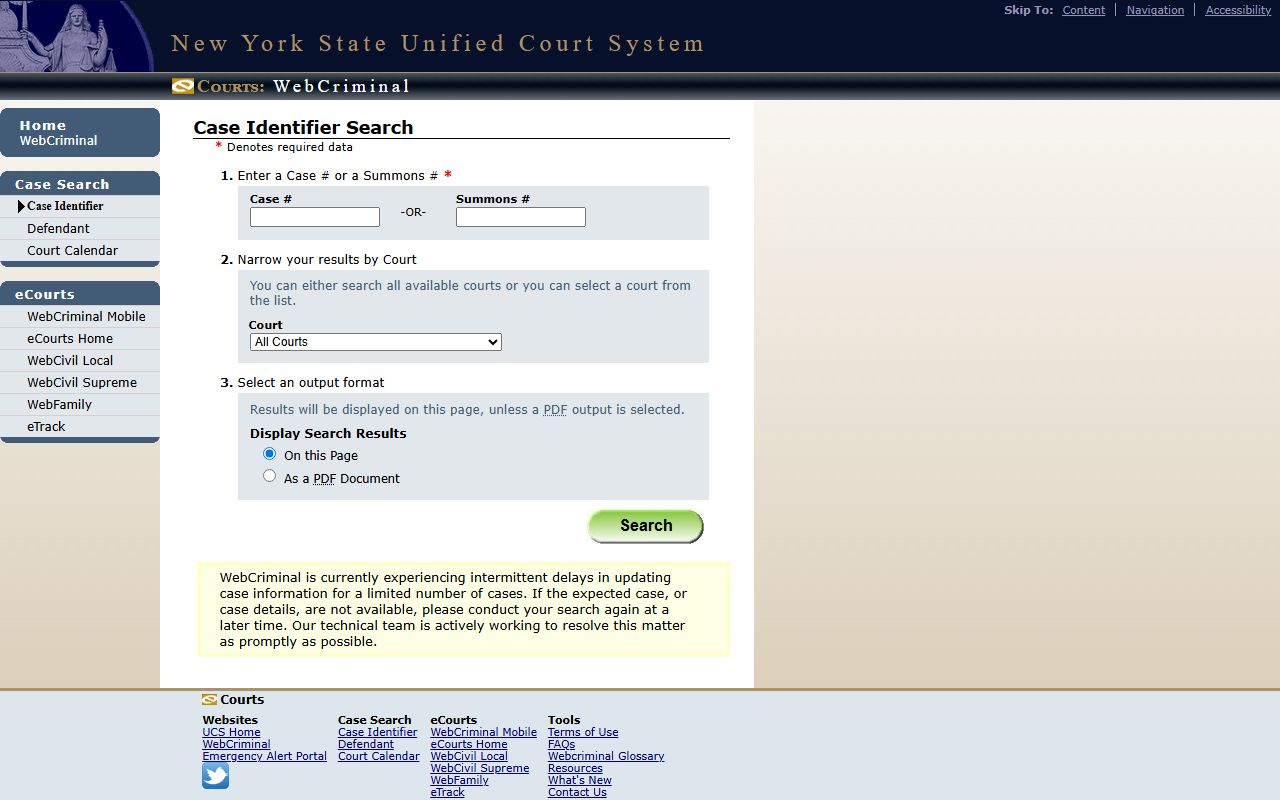
The case identifier search is the fast lookup when the case or summons number is already on a paper notice.
Arrest Records vs Criminal Court Records
The two are not the same record. An arrest record is created at booking by the arresting agency. A criminal court record is created when the District Attorney files an accusatory instrument and the court opens a case. A Bronx arrest can lead to no court case at all, a single court file, or in rare situations several court files for related charges.
| Arrest Record | Criminal Court Record | |
|---|---|---|
| Source | NYPD or arresting agency | Bronx Criminal Court or Bronx Supreme Criminal Term clerk |
| Created When | At booking | When DA files accusatory instrument |
| Public Online View | Not published as a Bronx blotter | WebCriminal name / case / calendar search |
| Contents | Booking entry, NYSID, charges as drafted, fingerprints | Pleadings, motions, calendar entries, disposition, sentence |
| Certified Copies | Through agency record request channels | Through Criminal Term Central Clerk or Bronx Criminal Court clerk |
Court file detail is on the Bronx court records page. Calendar and docket detail is on the Bronx court dockets page.
Charges vs Convictions in Bronx Criminal Court
A charge is an accusation. A conviction is a finding or plea of guilt. Bronx arrest records and the related Criminal Court file usually show both the original charge as filed and any later change at plea or verdict. Reading only the top charge can mislead a record check; the disposition is what counts.
| Charge | Conviction | |
|---|---|---|
| Stage | Filing or arraignment | Plea or verdict |
| Burden of Proof | Probable cause | Beyond a reasonable doubt |
| Public View | Visible in WebCriminal while case is open | Visible until sealed or until Clean Slate triggers |
| Sealing Path | CPL 160.50 if case ends in defendant's favor | CPL 160.59 application or Clean Slate after waiting period |
A Bronx arrest that ended in dismissal, acquittal, or another favorable termination is sealed under CPL 160.50 and will not appear on a standard public criminal-record check. A WebCriminal hit on an old Bronx case does not always mean a conviction.
Sealed vs Expunged Bronx Records
New York uses sealing, not broad adult expungement, for most criminal records. A Bronx sealed file still exists, but standard public access is blocked. Expungement in the destruction sense is rare in adult New York criminal practice; the user-facing distinction matters for background checks and CORI-style screening.
| Sealed | Expunged | |
|---|---|---|
| Visibility | Hidden from public; record still exists | Destroyed or treated as never existed |
| Law Enforcement | Limited statutory access | Very limited |
| Eligibility | CPL 160.50, 160.55, 160.58, 160.59, Clean Slate | Mostly juvenile or specific statutory contexts |
| Typical Bronx Use | Standard pathway after favorable result or 10-year wait | Rare in adult cases |
CPL 160.59 lets a person apply to seal up to two eligible convictions, with no more than one felony, after at least 10 years from sentence or release. Sex offenses, violent felonies, and Class A felonies are excluded. The NY CourtHelp sealing overview covers the eligibility rules in detail.
Mugshots and Booking Photos in the Bronx
NYPD takes a booking photo at intake. Mugshots are not posted on a public Bronx blotter and are not part of WebCriminal output. A booking photo may surface in DA press releases for named cases or in attorney discovery, but the NYC DOC custody lookup does not publish an inmate photo as a public field. The Bronx County Clerk has no mugshot library, and the Criminal Term FAQ does not offer photo retrieval.
For a personal copy of a booking photo, the standard paths are a defense attorney's discovery request, an agency record request to NYPD under FOIL, or in narrow situations a court motion. Bronx mugshots that show up on commercial websites are republished from older data leaks or third-party scrapes and should not be treated as official public records.
Statewide Criminal Records and CHRS
New York's official criminal history search is run by the Division of Criminal Justice Services. The DCJS Criminal History Record Search is a paid name-based search; the agency also processes fingerprint-based checks for licensing, employment, and personal review under separate statutory authority. DCJS results pull from sealed-eligible data per New York statute, so a sealed Bronx arrest under CPL 160.50 does not appear in a standard public CHRS report.
Federal records are separate. A federal criminal case from the Bronx would be in the U.S. District Court for the Southern District of New York and accessed through PACER. Federal sentencing or custody status routes through the Federal Bureau of Prisons inmate locator for active federal custody.
From Bronx Arrest to Arraignment
NYPD makes the arrest and processes the person at a Bronx precinct or Central Booking. The person is fingerprinted, photographed, and assigned a NYSID. The Bronx District Attorney drafts the accusatory instrument. The person is then produced for arraignment in Bronx Criminal Court at 215 East 161st Street for misdemeanors, summonses, and preliminary felony arraignments, or in Bronx Supreme Criminal Term at 265 East 161st Street for higher-level felony parts.
At arraignment the court reads the charges, sets release conditions, and either releases the person, sets bail, or remands. If bail is not posted or release is denied, the person is transferred into NYC Department of Correction custody. Most pretrial custody is on Rikers Island. The Bronx inmate records page covers the custody side in depth.
Note: A no-result on the DOC lookup right after a Bronx arrest usually means the person is still in NYPD or court processing, not that they have been released.
Bronx Warrants and Missed Court
A failure to appear in Bronx Criminal Court or Bronx Supreme Criminal Term can result in a bench warrant. Bench warrants do not appear on a public Bronx warrant list, but a WebCriminal case lookup may show a future appearance and a status that hints at warrant activity. A person who thinks a Bronx bench warrant is open should call the criminal court clerk and consult a defense attorney before walking into the courthouse.
Tax warrants, judgments, and liens are civil enforcement records and are handled by the Bronx County Clerk Dockets Department, not by the criminal courts. The Bronx warrant search page walks through both tracks.
Background Check Considerations
Casual record lookups and FCRA-regulated background checks are not the same product. An employer, landlord, or insurer running a background check on a Bronx resident must use an FCRA-compliant consumer reporting agency. A public WebCriminal search is not an FCRA report, will not include sealed records correctly, and does not satisfy New York's hiring or housing screening rules.
Important: This site is not an FCRA consumer reporting agency. Bronx records here cannot be used for employment, tenant, credit, or insurance screening.
Restricted Bronx Criminal Records
Bronx criminal records that are not openly searchable include juvenile delinquency files under Family Court Act § 375.1, juvenile-offender removal records under CPL § 725.15, favorable-termination sealings under CPL 160.50, partial sealings under CPL 160.55, conditional drug sealings under CPL 160.58, application-based sealings under CPL 160.59, Clean Slate automatic sealings, ongoing grand jury matters, sealed search warrants, mental-health proceedings, and adoption records linked to a Bronx Family Court file.
Family Court Act § 166 bars indiscriminate inspection of Bronx Family Court records. Family Court is at 900 Sheridan Avenue and decides records access case by case. The Bronx public records page covers the FOIL vs court-records distinction in full.