
How to Search Bronx County Court Records
Bronx County court files do not live in one database. The basic split is Supreme Court civil and matrimonial through WebCivil Supreme, criminal cases through WebCriminal, estates through WebSurrogate, and Bronx County Clerk filings, liens, and business records through the Bronx County Clerk online search. The portals are free and statewide, so the user must limit results to Bronx Supreme Court or a Bronx criminal court to keep the response useful.
Before starting, gather a party name, case or index number, year of filing if known, and the court type. The minimum-character rules matter. WebCriminal asks for at least the first two characters of the first and last names, or the first five characters of a corporation name. WebCivil Supreme accepts party, attorney, justice, or calendar searches, and the form is faster when one court is selected.
- Pick the case type. Civil over $50,000 or divorce goes to Supreme Court Civil Term. Felonies go to Supreme Criminal Term. Misdemeanors, summonses, and arraignments go to NYC Criminal Court. Estates go to Surrogate's Court. Family matters are not open to general public search.
- Open WebCivil Supreme for civil cases or WebCriminal for criminal cases. Limit the court field to Bronx Supreme Court, Bronx Criminal Court, Bronx Criminal Court - Summons, or Bronx Supreme Criminal Court.
- Enter the index number if you have it. Otherwise enter party name, attorney name, or justice name. WebCivil Supreme exposes filing years back to 1983 in the search form.
- Pick case status. Open (Active, Restored) hides closed files; All shows the full result set. Pick HTML or PDF output.
- Review the docket entries. For documents, follow the case to NYSCEF if it is an e-filed matter, or request a certified paper copy from the Bronx County Clerk.
The official 12th Judicial District landing page lists Bronx trial courts, addresses, and current operating notices, and the screenshot below shows the public-facing entry point most users see first.
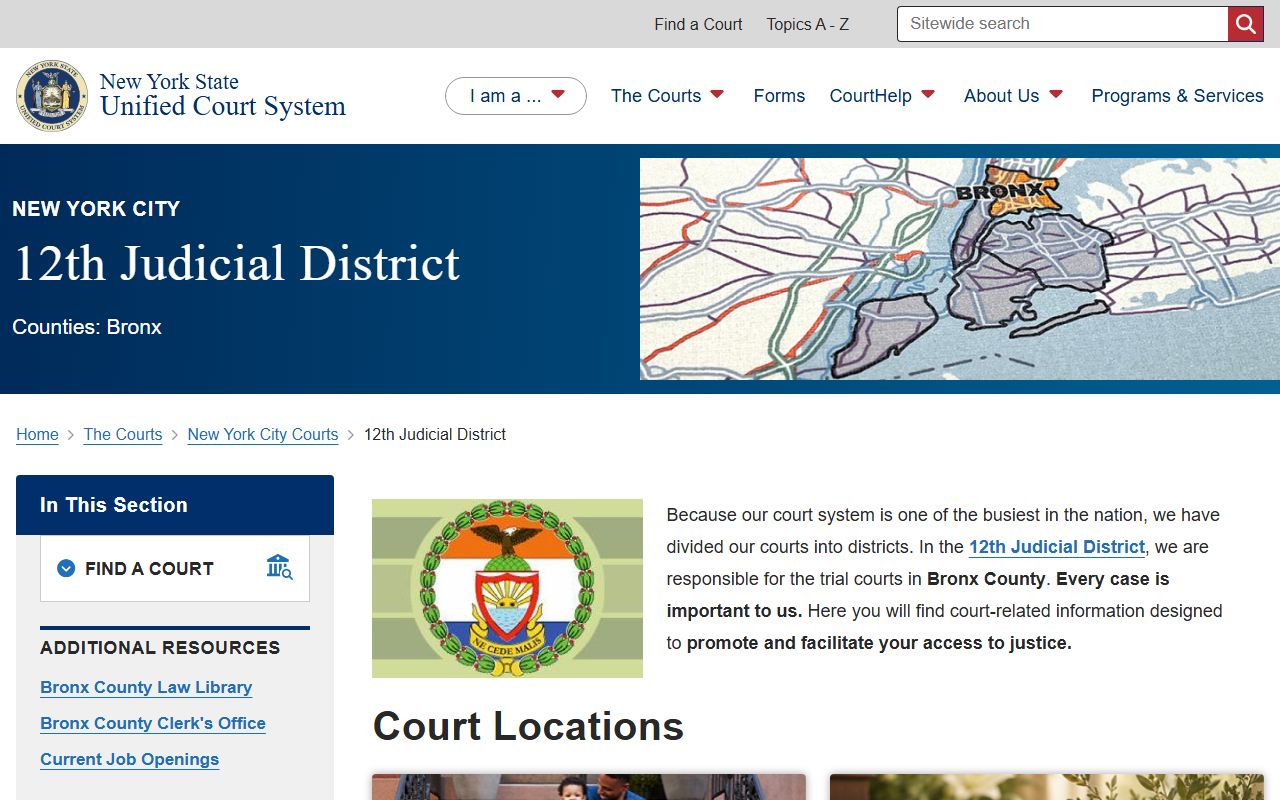
The page links into every Bronx trial court, the Bronx County Clerk's office, and the appellate divisions. A user looking for the right court should start there before opening a search portal.
The Bronx County Judicial System
Bronx County is the 12th Judicial District. New York's broad trial court is called Supreme Court, not District Court. The Bronx Supreme Court has a Civil Term at 851 Grand Concourse and a Criminal Term at 265 East 161st Street. NYC Criminal Court, NYC Civil Court, Housing Court, and Family Court handle limited-jurisdiction matters in the same neighborhood. Bronx Surrogate's Court at 851 Grand Concourse hears probate, administration, and guardianship cases.
Appeals from Bronx Supreme, Surrogate's, and Family Court go to the Appellate Division, First Department. Appeals from NYC Civil and Criminal Court generally go to the Appellate Term, First Department. The state's highest court is the New York Court of Appeals, not the Supreme Court.
Case flow: Criminal Court arraignment › Supreme Criminal Term (felony) › Appellate Division, First Department › Court of Appeals
| Court | Jurisdiction | Case Types |
|---|---|---|
| Supreme Court Civil Term | Statewide trial court, broad civil | Civil cases over $50,000, divorce/matrimonial, torts, malpractice, foreclosure, Article 78 |
| Supreme Court Criminal Term | Statewide trial court, felony | Felonies, indictments, weapons, drug, homicide, conspiracies |
| NYC Criminal Court | Limited city criminal | Arraignments, misdemeanors, summonses, desk appearance tickets |
| NYC Civil Court / Housing | Limited city civil | Small claims, landlord-tenant, housing repairs |
| Family Court | Statewide family | Custody, support, family offense, juvenile delinquency, PINS |
| Surrogate's Court | Statewide estate | Probate, administration, small estates, guardianship, accountings |
| Appellate Division, First Dept. | Appellate | Appeals from Bronx and New York County Supreme, Surrogate, Family |
The mismatch between the name "Supreme Court" and what people expect from a state high court is the most common Bronx records mistake. A divorce judgment from Bronx Supreme is a trial-level judgment, not a final appellate ruling.
Bronx County Courthouses
The historic Bronx County Courthouse at 851 Grand Concourse, also called the Mario Merola Building, houses Supreme Court Civil Term, the Bronx County Clerk, the Jury Division, and Surrogate's Court. Other Bronx court buildings cluster around East 161st Street near Yankee Stadium. Family Court and Housing Court sit on Sheridan Avenue and Grand Concourse respectively. Visitors should plan for security screening at every building.
Bronx County Courthouse (Mario Merola Building)
851 Grand Concourse
Bronx, NY 10451
718-618-3300
A look at the legacy 12th Judicial District page for Bronx Supreme Court shows the operations notices and clerk contacts that often change without much warning.
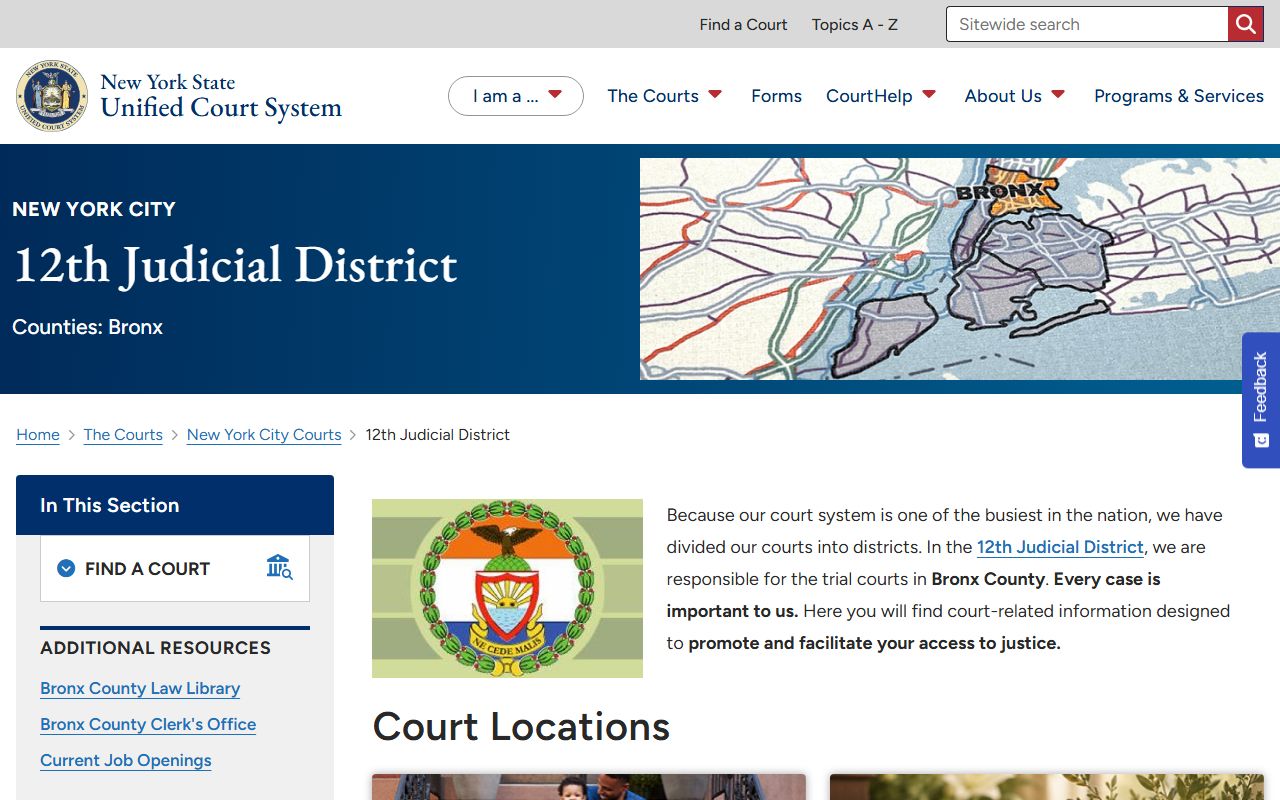
The same page lists the administrative judge for Supreme Criminal Term, Hon. Alvin Yearwood, and the chief clerk, Michelle Foggie. Calling ahead saves a wasted trip if a courtroom has moved.
Types of Court Records Available in Bronx County
Bronx County trial courts produce several record types, and each one sits with a different clerk. Supreme Court Civil Term records cover personal-injury complaints, medical malpractice, labor law, motor vehicle torts, foreclosure, name change, matrimonial actions, and judgments. Supreme Criminal Term files include indictments, motion practice, dispositions, certificates of disposition, and sentencing minutes. NYC Criminal Court records include accusatory instruments, calendars, and arraignment results. Family Court records include custody, support, family offense, juvenile delinquency, and PINS files, with much tighter access rules. Bronx Surrogate's Court holds probate, administration, small estate, guardianship, inventory, and accounting files.
Marriage records for marriages licensed in New York City are NYC City Clerk records, not Bronx County Clerk records, and date back to 1950. Divorce decrees are Supreme Court records filed with the Bronx County Clerk under strict access rules. Property deeds and mortgages are not Bronx County Clerk records; they are NYC City Register records searched through ACRIS.
- Civil Supreme records - tort, malpractice, foreclosure, Article 78, and matrimonial files. Search through WebCivil Supreme and the County Clerk portal.
- Criminal records - searchable through WebCriminal. Certified copies and certificates of disposition come from the criminal clerk.
- Marriage and divorce records - marriage records at NYC City Clerk; divorce decrees at Bronx County Clerk with party-only access.
- Surrogate's Court records - estates, wills, guardianships through WebSurrogate with a February 19, 2014 document cutoff.
- Traffic records - NYC moving violations are at DMV Traffic Violations Bureau, not Bronx Supreme Court.
- Liens, judgments, and tax warrants - filed with the Bronx County Clerk Dockets Department.
What Bronx County Court Records Show
A typical Bronx court record exposes a small set of fields no matter which portal is used. The portal output gives party identity, the assigned judge, the case status, and basic event history. Document images are limited and depend on whether the case is e-filed, restricted, or older than the portal's image cutoff.
| Field | What It Shows |
|---|---|
| Case / Index Number | Supreme Court civil uses an index number; criminal cases use case or summons identifiers; Surrogate files use file numbers. |
| Filing Year / Date | The year the action was commenced. Old cases are indexed by start year, not closing year. |
| Parties and Roles | Plaintiff/petitioner, defendant/respondent, debtor/creditor, decedent, fiduciary, guardian, attorney/firm. |
| Court and County | Bronx Supreme Civil, Bronx Supreme Criminal, Bronx Criminal Court, Bronx Family Court, Bronx Surrogate's Court, or Housing Court. |
| Case Status | Open, active, restored, all/closed, sealed, disposed, transferred, or future appearance. |
| Judge / Justice / Part | WebCivil and WebCriminal calendar searches expose justice and court part. |
| Appearance Data | Date, time, purpose, judge, and whether a future appearance is on the calendar. |
| Disposition / Sentence | Dismissal, guilty plea, verdict, sentence, judgment amount, or estate distribution. |
Some fields stay private even on a public record. Social Security numbers, financial account numbers, minor-identifying information, sealed criminal results, and family or adoption file content are not exposed. See the court records subpage for a full sample case-record field table.
Public Access Laws for Bronx County Court Records
New York public-record access splits into two tracks. Agency records sit under the Freedom of Information Law in Public Officers Law Article 6. Court records are judiciary records and are controlled by court statutes, judiciary rules, and clerk procedures. A police FOIL request follows one path; a Bronx Supreme Court certified paper follows another. The full FOIL text from the New York Department of State spells out the agency side.
Key Statutes:
Public Officers Law § 87 - Sets the agency duty to make most records available, subject to enumerated exemptions and reasonable fees for copies.
CPL § 160.50 - Seals arrest and prosecution records after a criminal action terminates in the accused's favor, with specific access exceptions.
CPL § 160.59 - Lets eligible people apply to seal up to two convictions after 10 years, with no more than one felony and a list of excluded offenses.
Family Court Act § 166 - Prohibits indiscriminate public inspection of Bronx Family Court files; access is decided case by case.
22 NYCRR § 216.1 - Requires written findings of good cause before a civil court file is sealed.
FOIL denials follow the appeal path in Public Officers Law § 89. Court-record denials usually require motion practice, statutory authority, or a court order. The confidential records guide from the Unified Court System lists the statutes that restrict access by record type.
Records That Are Restricted or Confidential
Bronx court restrictions cover several record categories. Family Court Act § 166 limits Family Court access. CPL § 160.50, 160.55, 160.58, and 160.59 cover criminal sealing. Domestic Relations Law confidentiality keeps Bronx divorce files out of general public view. Surrogate's Court Uniform Rule 207.64 blocks restricted estate files. Grand jury minutes are secret unless a court orders disclosure. Juvenile delinquency files can be sealed under Family Court Act § 375.1.
To open a sealed file, the requester usually files a motion in the court that holds the record. The CPL 160.59 application packet includes a notice of motion, an affidavit in support, a certificate of disposition, and an affidavit of service on the District Attorney. The DA can oppose. Clean Slate adds automatic sealing for many eligible convictions after statutory waiting periods, with law-enforcement, court, licensing, and firearm exceptions.
Specialty Courts in Bronx County
The Unified Court System has run problem-solving courts for more than two decades. Drug treatment courts and mental health courts focus on treatment outcomes instead of standard prosecution paths. Veterans Treatment Courts connect eligible veterans with VA services, treatment, and supervision. Bronx criminal cases that qualify for treatment-court handling start in Bronx Criminal Court or Supreme Criminal Term and are routed by referral, charge level, and eligibility screening.
The Bronx District Attorney's office under Darcel D. Clark added a Conviction Integrity Bureau, a Public Integrity Bureau, and a Rikers Island Prosecution Bureau, plus enhanced services for victims of domestic violence, sexual assault, and child abuse. DA initiatives are not the same as court-operated problem-solving courts, but they shape what gets charged, diverted, or referred to a specialty track.
Bronx County Sheriff and Jail
Bronx County does not run a separate county jail. People arrested in the Bronx and held after arraignment are in NYC Department of Correction custody, almost always in a Rikers Island facility. The current FY2026 Preliminary Mayor's Management Report says DOC runs eight jail facilities on Rikers, plus court holding facilities in every borough and two hospital prison wards. DOC's general contact line is 718-546-1500.
For the live jail roster, use NYC DOC's Person in Custody Lookup. The lookup shows current DOC custody location and basic case information; it does not cover people in NYPD custody, state custody, or federal custody. See the Bronx County inmate records page for the full search walkthrough and the warrant records page for warrant-related guidance.
Marriage, Divorce, and Surrogate's Court
Vital and probate records sit in three separate offices in Bronx County. Marriage records for NYC marriages from 1950 forward come from NYC City Clerk through appointment or mail. Divorce decrees are Supreme Court records filed with the Bronx County Clerk, but certified copies are limited to a party, attorney of record, or a person with notarized authorization. Estate matters go to Bronx Surrogate's Court, which uses WebSurrogate for public file searches. See Bronx County marriage and divorce records for the full process.
- Testator
- The person who made and signed a will. The original will is offered for probate after death.
- Executor
- The person named in the will to administer the estate. Letters Testamentary are issued by the Surrogate.
- Administrator
- The person appointed by Surrogate's Court when the decedent left no will. Letters of Administration are issued by the court.
- Intestate
- The legal status of dying without a valid will. Distribution follows New York intestacy rules.
- Guardian (Article 17 / 17A)
- A court-appointed adult who manages the person or property of a minor or developmentally disabled adult under SCPA Articles 17 and 17A.
Bronx County Court Records Fees
The Bronx County Clerk fee schedule is set by statute and court rule. All fees are payable by U.S. postal money order, certified check, or NYS attorney's check; cash is only taken in person; personal checks are not accepted. The Clerk asks for separate money orders for each two-year search period and separate money orders for certification or exemplification when paying by mail.
| Item | Amount |
|---|---|
| Supreme Court action index number | $210 |
| RPAPL Article 13 foreclosure index number | $400 |
| Note of issue | $30 |
| Motion / cross-motion | $45 |
| Order to show cause | $45 |
| Request for Judicial Intervention | $95 |
| Notice of appeal | $65 |
| Certification of a Supreme Court document (including divorce decree) | $8 |
| Certification of a business / corporation document | $10 |
| Exemplified copy | $25 plus certification and copy fees |
| Search certificate, two-year period | $10 |
| Each additional two-year search period | $5 |
| Plain copy per page (minimum $1.50) | $0.65 |
| Certificate of disposition (Criminal Term) | $10 |
How to Interpret Bronx County Court Records
A docket reads like a timeline. Each row is an event: a filing, an order, an appearance, a motion, a stipulation, or a judgment. Civil case statuses appear as Active, Restored, Disposed, or Closed. Criminal cases show charges by Penal Law section and disposition codes such as Convicted on Plea, Convicted After Trial, Dismissed, Acquitted, or ACD (adjournment in contemplation of dismissal).
Charges are not the same as convictions. A row that shows a felony charge at indictment may be reduced or dismissed at disposition. The same case may also show a sealed line after CPL 160.50 sealing if the action terminated in the defendant's favor. Sentencing rows show jail time, probation, conditional discharge, fines, restitution, mandatory surcharges, and sex-offender registration where applicable.
Reading a Surrogate file follows a different pattern. Probate and administration cases open with a petition, move to a citation, and end in Letters Testamentary or Letters of Administration. Inventory and accounting filings come later, often years after letters issue.
Accuracy and Record Limitations
Online portals do not update in real time. WebCriminal warns that case information is sometimes delayed and asks users to search again later. Pre-1992 Bronx Supreme index numbers sit on microfiche and require an in-person search or a written staff search. Guest searches on the Bronx County Clerk portal return only public information; attorney accounts see more. WebSurrogate only links document images for unrestricted records filed on or after February 19, 2014.
Note: Before relying on a portal result for a court date, sentence, or estate filing, confirm the detail with the relevant Bronx clerk's office in person or by phone.
History of Bronx County Courts
Bronx County is coextensive with the Borough of the Bronx. The borough became a separate county in 1914 after earlier history as part of New York County and Westchester County. The Mario Merola Building at 851 Grand Concourse is a historic civic landmark and remains the central public-records location because the Bronx County Clerk, Supreme Court Civil Term, Jury Division, and Surrogate's Court all operate there.
The Hall of Justice and Criminal Term complex at East 161st Street consolidated major criminal court operations near the older courthouse. The Bronx Criminal Court address split across 215 and 265 East 161st Street reflects the practical reality that arraignments, Supreme Criminal Term, DA operations, and court production functions cluster in the same high-volume corridor. Court technology milestones include statewide eCourts search tools, WebCivil Supreme, WebCriminal, NYSCEF electronic filing, and WebSurrogate. The Bronx County Clerk's Dockets Department still handles the paper trail for judgments, liens, and pre-2025 state tax warrants.
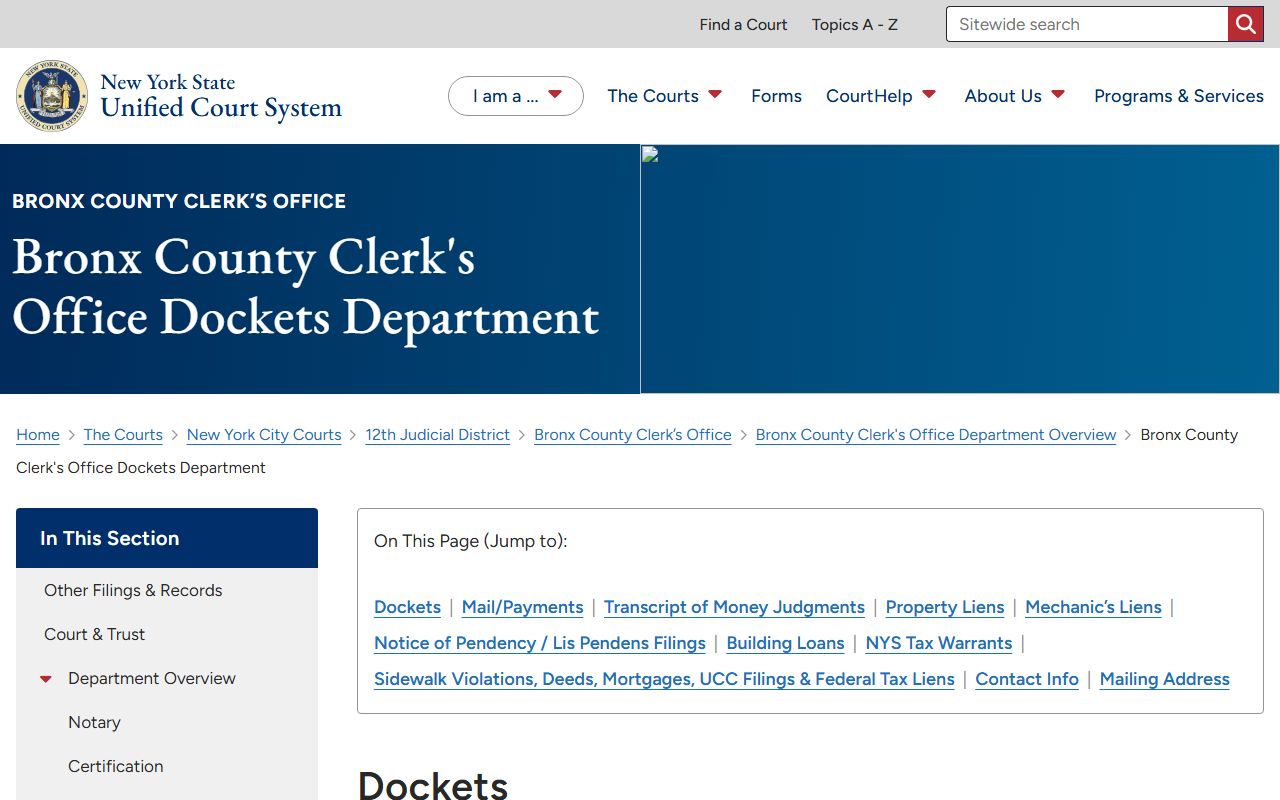
The Dockets page also flags an important 2025 change: New York State Tax Department tax warrants filed on or after July 1, 2025 are filed electronically with the Department of State rather than the County Clerk.
Self-Help and Legal Aid in Bronx County
Bronx County's Family Court page lists a Help Center at 718-618-2150 and a Child Support Service Center at 718-618-2155. The official Bronx Family Court county page covers hours, magnetometer screening, accessibility, and Spanish and Albanian interpreters on site, with other languages and sign language on request. The Bronx County Law Library is also a public resource.
For criminal cases, The Bronx Defenders offers an interdisciplinary public-defense model with criminal defense, civil legal help, family defense, immigration, social work, and advocacy. Legal Aid Society and Legal Services NYC Bronx also handle eligible cases. City Bar Justice Center runs an estate planning project linked through Bronx Surrogate's Court.
Frequently Asked Questions
How do I search Bronx Supreme civil cases?
Use WebCivil Supreme and limit the court to Bronx Supreme Court. The form accepts an index number, a party name, an attorney or firm name, or a justice name. You can narrow by filing year back to 1983, by case status, and by future appearances. For certified paper copies, use the Bronx County Clerk records process.
Where is the Bronx County Clerk's office?
The Bronx County Clerk is at 851 Grand Concourse, Room 118, Bronx, NY 10451. The main phone is 718-618-3300. Room 118 hours are Monday through Friday, 9:00 AM to 4:45 PM, with a lunch closure from 1:00 PM to 2:00 PM. Visitors should not arrive at 1:00 PM expecting service.
Are Bronx Family Court records public?
No, not in the open-browse sense. Family Court Act § 166 blocks indiscriminate public inspection. Parties and attorneys of record can access their files; others need case-by-case permission. Juvenile, abuse/neglect, and adoption files have additional protections.
More on the Bronx County Court Records FAQ page.